Monmouth 250 - Bird ID Challenge
In celebration of America’s 250th Birthday and as part of
MonmouthNJ 250, the Monmouth County Park System Naturalists are launching a bird identification challenge to document 250 distinct bird species within the county during our programs.
See details.
* * * * * *
Each visit to your county parks offers a chance to experience the wonders of nature. Whether it’s the anticipated first signs of spring or an unexpected avian visitor, nature never fails to delight. While our Nature Calendar lists many things to look for during your visits throughout the year, here are some things that are happening now:
Clapper Rail
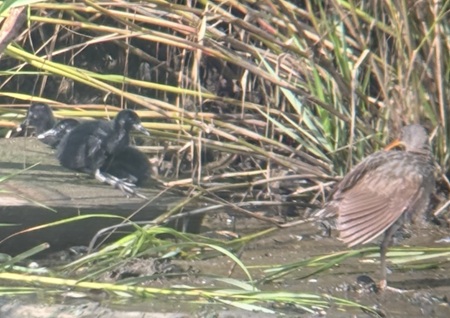
During our recent Birding Conaskonk Point program, our Naturalist staff spotted an extra special surprise. Hidden silently on the muddy edges of the tidal saltmarsh was a Clapper Rail, which is always special on its own, but just behind the adult bird on the left was an extra special treat. Three young clapper rail chicks were sunning themselves out in the open. These small fluffy black-colored chicks can be seen with the front chick showing off its awkwardly large looking feet and bi-colored bill. It will take some time for the chick to grow into adulthood and look more like the browned adult birds we recognize more easily. (posted 8/6/2026)
Black Skimmer

The Black Skimmer is a coastal bird with a unique elongated lower mandible, which they use to skim the water surface for fish along coastal inlets. (posted 7/28/2026)
Oblique-Lined Tiger Beetle

The Oblique-lined Tiger beetle is a fast, predatory beetle with pale, angular wing markings that hunts smaller insects across sandy paths. (posted 7/28/2026)
Eastern Meadow Vole

Eastern Meadow Vole is a small, stocky rodent that creates complex runway networks through dense marsh grasses and overgrown fields. Rarely seen above the surface. (posted 7/28/2026)
Cabbage White

Cabbage White are a very common, widespread white butterfly visible in nearly every open backyard, garden, and agricultural field. (posted 6/17/2026)
Green-striped Grasshopper

Green-striped Grasshopper is an early-emerging grasshopper found in fields, notable for its striking green stripe and spring clicking flights that prefers wet areas. (posted 6/17/2026)
Red Fox

Red fox are highly active in the spring as parents hunt around meadows and suburbs to feed their playful, fast-growing spring kits. (posted 6/17/2026)
Baltimore Oriole

Baltimore oriole is a striking orange-and-black songbird that builds hanging woven nests in mature deciduous trees. (posted 6/17/2026)
Pileated Woodpecker
Pileated Woodpeckers are New Jersey’s largest woodpecker species. Easily recognized by its striking red crest and bold black and white markings. This male was spotted at Holmdel Park, chiseling away at a cherry blossom tree, using its long-barbed covered tongue to snag some insects from beneath the bark. The bulk of their diet consists of insects, with carpenter ants being their favorite, but also enjoy a variety of seeds, fruit, and nuts. Woodpeckers are quite vocal and this one was heard before it was spotted, making a loud series of piping calls. (posted 4/24/2026)
Eastern Tiger Swallowtail

With the unseasonably warm weather we’ve been experiencing comes some early appearances in the natural world, including the first eastern tiger swallowtail of the season. Typically, these striking yellow-and-black butterflies begin emerging closer to the end of April, making this sighting a welcome, and slightly early, sign of spring’s arrival.
The individuals we see this early in the season are butterflies that have overwintered in the chrysalis stage, tucked safely away through the cold months. As the temperatures rise and daylight increases, they emerge, ready to feed, mate, and continue their life cycle.
Eastern tiger swallowtails are among the most recognizable butterflies in our region, often seen fluttering along forest edges, gardens, and waterways. This particular individual appears to be a female, identifiable by the band of blue scales along the lower portion of its wings.
Keep an eye out as the days continue to warm; more of these beautiful butterflies will soon join the landscape. (posted 4/17/2026)
A Forest Dwelling Clam?
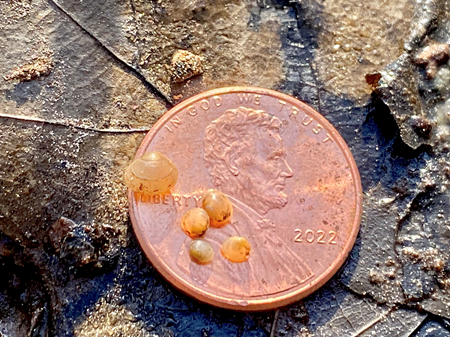
Fingernail Clams
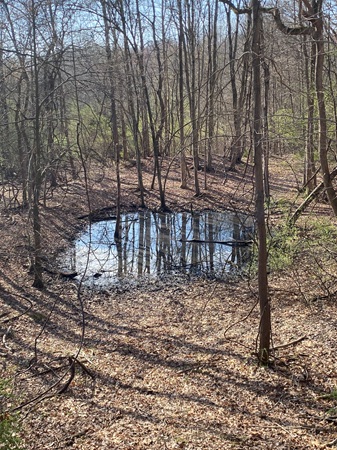
Vernal Pool
Clams are one of the last animals most people would expect to find on a hike through the forest, yet that’s exactly what was discovered this weekend at the
Manasquan River Greenway, Farmingdale. These fingernail clams (also known as pea clams) can be found by the thousands in temporary, disconnected puddles known as vernal pools. These minuscule mollusks grow to a maximum of an inch long and can live for several years by filter feeding on algae. As the water level in their pool falls and eventually dries, the fingernail clam will use its muscular foot to dig and pull its body up to 8 inches underground where they can remain dormant for months at a time without water. Little is known about how these clams populate such isolated bodies of water. The leading theory speculates the clams may be catching a ride on other inhabitants of the vernal pool such as amphibians or water fowl who can travel from one pool to another. (posted 4/9/2026)
American Kestrel

American Kestrel are a beautiful small falcon that can be found in Monmouth County. These small falcons can be found hunting over open fields, catching food such as insets and other small prey. An interesting fact about these birds is that they are cavity nesters, typically using hollows in trees as place to raise a clutch of eggs. (posted 4/8/2026)
Harris Sparrow

Sparrows in general are not usually know for drawing a lot of attention. However, a recent unexpected visitor has shown up in Monmouth County that really is a showstopper. The Harris Sparrow is a large bulky sparrow, with a black bib and pink bill, and streaky brown underparts; with white belly with streaked flanks. This species in particular only breeds in the tundra of northern central Canada, and the range map show them only overwintering in central United States. Luckily enough, this species can wander, and this little gem has been creating quite a stir for local birders. (posted 4/2/2026)
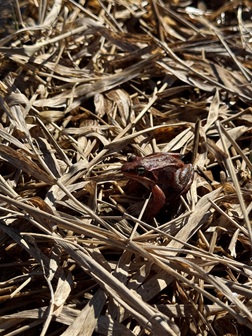
Wood Frogs

Click on each image to see enlarged.
It’s spring and the vernal pools are filled once again with life! They provide temporary nurseries for a variety of amphibians and invertebrates. These shallow pools fill with water from snow melt and rain in the spring, and many frogs and salamanders wait all winter for the right conditions to lay their eggs in them.
This warm and sunny week has brought hundreds of Wood Frogs to our vernal fields at
Dorbrook Recreation Area, Colts Neck. You can identify them by their dark masked snout and eyes, and rusty red to dark brown body color.
These frogs are more seen during breeding season, due to their “explosive” breeding behavior in the spring and then return to their more solitaire terrestrial lifestyle, hidden beneath leaf litter or in moist shaded areas. (posted 4/2/2026)
Hidden Gems
Sometimes large flocks of waterfowl form on lakes, rivers and ponds. These congregations of birds are a spectacle to see and a great chance to practice identification skills. We recently looked into a flock hundreds of Mallards, American Black Ducks, and Canada Geese and found a few other species mixed in.

Northern Pintail - See enlarged image.
A Northern Pintail male stuck out with its beautiful thin long neck, and white breast and neck stripe that contrasts nicely with its brown head. These elegant birds also have a beautiful long tail.
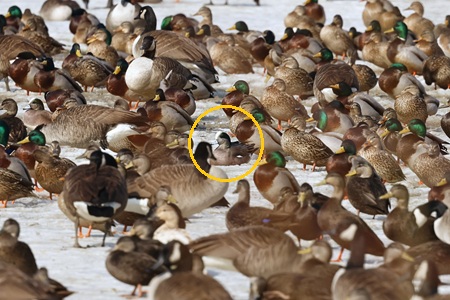
American Wigeon - See enlarged image.
The other hidden gem, a male American Wigeon, stood out with its wide green stripe behind the eye, green head with white cap, and reddish body color. It can take some practice to find something different in the mix, but it’s a fun challenge! (posted 3/13/2026)
Winter Bird Excursion

Long-Tailed Duck
On a recent winter bird excursion, we visited some of our coastal waterways and were greeted by some beautiful winter ducks including the Long-Tailed Duck. This small sea duck makes a big impression! Especially the male, with its very long slender tail feathers, white head that contrasts with its dark face and neck, and white plumes over its dark back. It also has a slight pink patch on its black bill.
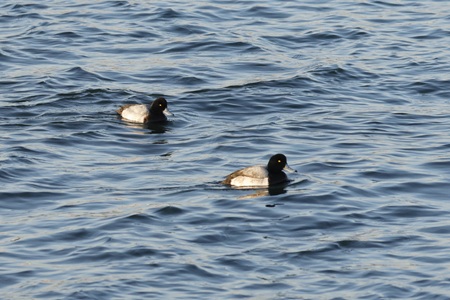
Greater scaup
The other species of beautiful male ducks seen were Greater scaup. They have yellow eyes and a big dark rounded head that can give a green iridescent hue in good light. Their dark head, chest and rear contrast with their white sides and gray checkered back. Both species can often be seen actively diving in search of food. (posted 3/12/2026)
Iceland Gull

Winter is a great time to search for rarities. Among the birds to search for is one of the tougher family of birds - the gulls. With multiple years of molts before reaching adulthood, and both breeding and non-breeding differences per year, it can be a lot to remember. Thankfully our white wing gulls can really stand out in the crowd. This Iceland gull is a young bird that has pale whiteish wingtips that extend beyond the tail when resting, as well as a slender bill and small size. (posted 3/11/2026)
Horned Lark

Horned Lark are a beautiful small song bird that can often be found on bare or tilled fields. They actively hunt for insects and seeds, so their movement sometimes gives them away as they walk or run along the ground.
Once you notice them, they are quite stunning with their black and yellow faces. This mostly brown sparrow-like bird has a black chest band and a mask highlighted against the yellow of their face and throat. Males have feathers that sometimes stick upright, giving them the illusion of having horns. (posted 3/11/2026)
Lapland Longspur

A special winter visitor that can sometimes be found in New Jersey is the Lapland longspur. The name “longspur” refers to the unusually long hind claw on this species and others in its genus. They look similar to sparrows and can sometimes be in mixed flocks with American Pipits, Horned Larks, Snow Bunting, Vesper and Song sparrows on fields or bare-to- sparsely vegetated grounds. We see these birds in their non-breeding plumage, which adds to the difficulty of detecting this species. They have a heavily streaked back and crown, dark outline on the ear, black streaking on the flanks, and a pop of rusty patch in the wing. Spotting one was a highlight of a recent Winter Bird Excursion bus trip. (posted 2/27/2026)
Dark-eyed Junco

Dark-eyed Junco are a common winter visitor for us in Monmouth County. They are a medium sized slate gray colored sparrow with a pink bill and white belly, and have notable white outer tail feathers. The slate-colored variety is the common subspecies seen on the East Coast. They are often spotted feeding on the ground at the edge of fields and forests. Be sure to look for them soon though, because as spring approaches these “snow birds” will be heading north. (posted 2/27/2026)
American Tree Sparrow

A beautiful sparrow that has unfortunately had steep population declines in recent years is the American Tree Sparrow. Do not let the name mislead you, these birds prefer to feed on the ground and not in trees. These sparrows have a rusty cap and eyeline, with a gray face, and a bi-colored bill. We often see them during the winter months in our area, before they migrate further north to breeding grounds in the tundra during the summer.(posted 2/27/2026)
Eastern Bluebird
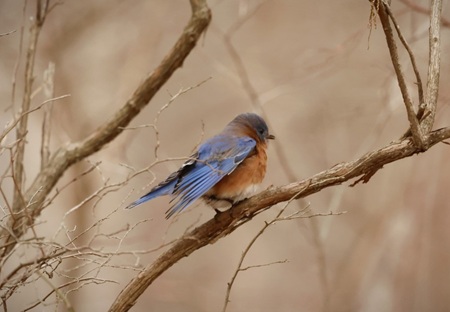
A favorite bird found in our parks all year long is this beautiful pop of color - the Eastern Bluebird. The male is royal blue on its back and head, a warm red wash on its breast, and a white belly. Many of our local Monmouth County Parks have successfully created bluebird trails by posting man-made nesting boxes. These birds are often seen perched on wires, fences, or tree limbs that overlook open fields as they hunt for insects. In winter, they switch their diet to mostly wild fruit and berries. (posted 2/27/2026)
Fox Sparrow

A beautiful winter visitor to feeders that typically shows up when it snows is the Fox Sparrow. These secretive sparrows have a beautiful red and brown coloration, and usually go unnoticed as they hide in thickets and feed on the ground in leaflitter. During the summer, you can hear their beautiful whistling song usually long before you seen them. During the recent Backyard Bird Count, one was fairly cooperative along the bushes near the feeders. (posted 2/18/2026)
Eastern Meadowlarks
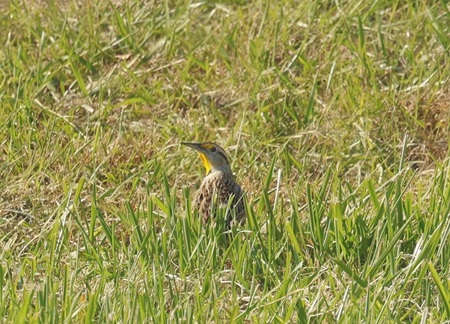
On a recent Winter Bird Excursion bus trip, our group had the luck of stumbling onto a brightly colored gem hidden along a field edge. Eastern meadowlarks are a grassland specialist that can go unnoticed if you are not lucky enough to hear one sing its beautiful whistled tune or have one flash out of a field and take flight. Although often hidden as they feed along the floor, there is no mistaking the bright-yellow underparts with a pop of black chest bib. (posted 2/18/2026)
Red-headed Woodpecker
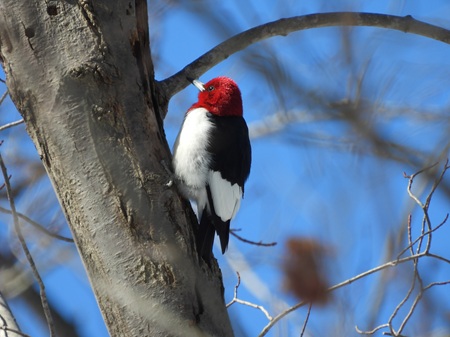
Photo was taken by park patron Gregg Eldred on a recent walk during the Great Backyard Bird Count.
A special visitor has been spending its winter in the Monmouth County Parks. A Red-headed Woodpecker has been seen stashing and storing food along our trails. As adults, these stunning birds have bright crimson heads, white bellies, and black and white wing patches. Most Red-headed woodpeckers are spotted in Monmouth County during migration, but periodically they will overwinter here in areas with good habitat. (posted 2/17/2026)
North American River Otter
Did you know that there are otters in New Jersey? Most people do not realize that yes, in fact, they can even be found in Monmouth County. Although sightings are quite rare, the North American River Otter (Lutra canadensis) is one of the five members of the mustelid (weasel) family found in New Jersey. River otters are found in healthy waterways that have an abundance of the appropriate diet. They primarily eat fish, frogs, turtles, crayfish, insects, snails, clams, and mussels and other crustaceans. They are most active during dawn and dusk in warmer months, but can sometimes be found out during the day especially in the winter. (posted 1/28/2026)